If you’re building or upgrading a small three-wheel motor car or a compact remote-controlled chassis, these 3 wheel motor car kits and gearboxes offer compact power, easy wiring, and reliable gear ratios. This guide targets hobbyists and students seeking affordable, plug-and-play options for Arduino projects, DIY robots, or simple RC cars. The top picks below help you choose by drive voltage, torque, and ease of integration—whether you’re a beginner or an experienced builder.
Product at a Glance
- DORHEA 4Set DC Electric TT Prewired Gear Motor Wheel Kit — 3V–12V, 69mm tires
- SquEqu 4 Pack Micro N20 Gear Motor Wheels With Rubber Tire — 3mm shaft, D-hole wheels
- Stemedu TT Motor Electric Gearbox 200RPM — 3V–6V, 1:48 ratio, dual shaft
- KEAcvise 8 Sets TT Motor Gearbox Wheel Kit — 3V–6V, 1:48 ratio, 200rpm
- ACEIRMC 2 Set TT Motor With Leads — 3V–6V, 1:48 ratio, 200RPM, wired
The following table helps compare key attributes for these selections: motor voltage range, gear ratio, estimated no-load speed, and wheel compatibility. Use it to decide which product aligns with your three-wheel motor car goals and skill level.
| Product | ||||
|---|---|---|---|---|
| DORHEA 4Set | 3–12V | 1:48 (approx) | ~200 RPM (at 4.5V) | 69mm tires; 2.75″” diameter |
| SquEqu 4 Pack | 3–6V | — | Included N20 motors vary by config | D-hole wheels, rubber tires |
| Stemedu TT Motor | 3–6V | 1:48 | 200RPM | 65mm outer diameter tires |
| KEAcvise 8 Sets | 3–6V | 1:48 | 200RPM (approx) | Includes tire wheels; direct plug-and-play |
| ACEIRMC 2 Set | 3–6V | 1:48 | 200RPM (approx) | Includes wheel kit and leads |
DORHEA 4Set DC Electric TT Prewired Gear Motor Wheel Kit

Best for beginners and hobbyists building a compact three-wheel vehicle with straightforward wiring. This kit includes four plastic tires and TT motors designed for 3V–12V operation, with a recommended 6–8V range for better performance. The 69mm tires provide balanced grip for small robots or toy cars. Choose this if you want a ready-to-wire, versatile kit that works with common battery packs and simple breadboard connections. Caution: higher voltages can overheat the motor if run continuously without adequate cooling.
SquEqu 4 Pack Micro N20 Gear Motor Wheels

Best for compact projects needing lightweight wheel sets. These wheels are designed for N20 motors, with a rubber tire and a plastic wheel hub. They are ideal for small DIY robots, micro RC cars, or educational kits where space is limited. Best used with small 3–6V gear motors. Consider this choice if you need quick wheel replacements or a tight, low-profile build. Limitation: wheel size and compatibility are tied to N20 motor standards, so blend with non-matching motor families may require adapters.
Stemedu TT Motor Electric Gearbox 200RPM

Best for Arduino-based car chassis projects and learners who want a robust 1:48 gear ratio. The kit includes dual shafts and a plastic tire wheel assembly, with a 65mm tire footprint. This option is well-suited for tabletop robots and small rovers requiring predictable speed and torque at low voltage. Choose this if you value a compact, tested gearbox and easy integration with standard Arduino components. Caution: wheel size may limit high-speed experiments on larger tracks.
KEAcvise 8 Sets TT Motor Gearbox Wheel Kit
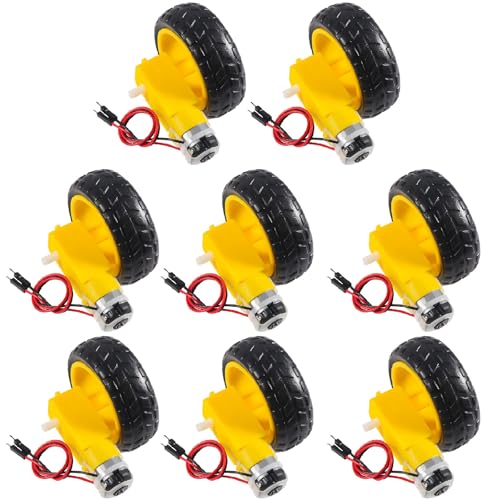
Best for bulk projects and classroom kits. KEAcvise provides eight sets of 3–6V TT motors with a 1:48 gearbox and tire wheels, offering a scalable solution for multiple DIY vehicles. It emphasizes direct compatibility with breadboards or terminal blocks via included 200mm wires with standard connectors. This is a strong pick when you need repeatable parts across several builds. Limitation: bulk packaging may be more than needed for a single project, increasing storage considerations.
ACEIRMC 2 Set TT Motor With Leads

Best for plug-and-play projects that require immediate setup with minimal wiring. ACEIRMC provides two TT motors with leads, a 1:48 gearbox, and 200RPM, designed to connect easily to breadboards or controllers. This option supports quick prototyping for students and hobbyists. Caution: only two motors in the set may limit high-torque builds or larger vehicles needing more drive power.
Buying Guide: Key Considerations For 3 Wheel Motor Cars
- Voltage compatibility: Most kits run on 3–6V or up to 12V. Plan your battery supply accordingly to avoid overheating and to achieve the intended speed.
- Gear ratio and torque: A 1:48 gear ratio is common and provides solid low-end torque for small vehicles. Higher torque helps with steeper gradients or heavier builds.
- Wheel size and grip: Tire diameter and tread affect traction and ride stability. Larger wheels improve speed on smooth surfaces but may reduce torque.
- Wiring and connectors: Look for pre-wired options or easy plug-and-play cables if you’re newer to electronics. Breadboard-ready connectors simplify testing.
- Durability and materials: Plastic wheels are lightweight and economical; metal components offer longer life under heavy use. Consider your build environment.
- Expansion and compatibility: If you plan to scale to multiple wheels or integrate with an L298N board or microcontrollers, ensure motor leads and connectors match your controller’s inputs.
FAQ
- What voltage range is safest for these motors?
Most kits operate at 3–6V, with some supporting up to 12V. For beginners, start at 3–6V to test movement and gradually increase within the motor’s recommended range.
- Is a 1:48 gear ratio suitable for small cars?
Yes. A 1:48 ratio provides a balance of speed and torque suitable for compact three-wheel builds and educational projects.
- Can I mix wheel sizes on a single chassis?
Mixing wheel sizes can cause steering imbalance and uneven torque distribution. Use matched wheels for consistent performance.
- Do these kits require special tools?
Basic tools (screwdrivers, wire strippers, and a multimeter) are usually sufficient. Some kits may need soldering for permanent connections.
- Which kit is best for a classroom setting?
KEAcvise 8 Sets is a scalable option for multiple projects, while ACEIRMC 2 Set is ideal for quick demonstrations and small group experiments.