Exploring four-cylinder engine model kits offers a hands-on way to learn about piston motion, crankshafts, and valve timing. The kits below combine working models, clear visibility, and instructional guides to suit kids, teens, and adults who enjoy engineering projects. Each option demonstrates authentic engine dynamics while supporting STEM learning, critical thinking, and fine motor skills. The selections here emphasize build quality, instructional value, and runnable mechanisms without relying on expensive, full-sized engines.
| Product | Brand | Approx. Pieces | Key Benefit |
|---|---|---|---|
| National Geographic 4-Cylinder Engine Building Kit | Blue Marble | 175+ | Visible, working engine with learning guide |
| BseSparklion L4 Engine Building Kit | BseSparklion | 853 | Realistic L4 engine with USB motor |
| 4-Cylinder Engine Model Kit for Kids | MyrzNFX | 853 | Kid-friendly, battery-powered motion |
| TECHING Mini Diesel Engine Model Kit | TECHING | 300+ | OHV four-cylinder diesel replica |
| Mould King 10087 L4 Engine Building Kit | Mould King | 1787 | Large, intricate V4-like inline engine with detailed parts |
National Geographic 4-Cylinder Engine Kit
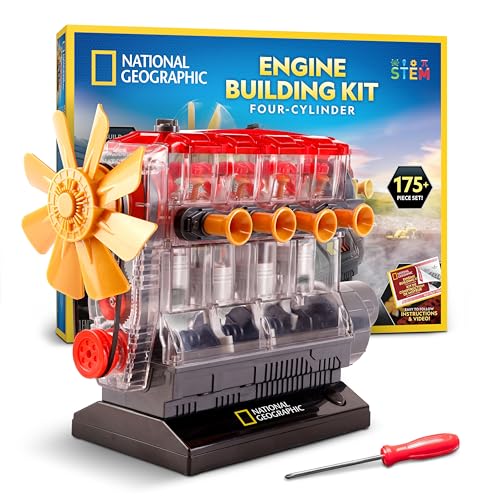
The National Geographic 4-Cylinder Engine Building Kit provides a transparent, 175+ piece platform for constructing a working four-cylinder engine. Pistons, valves, and gears are designed to move in a realistic manner, giving a clear view of internal mechanics. The kit relies on three AA batteries (not included) to power moving parts, allowing hands-on observation of cranks and connecting rods. A comprehensive Learning Guide and illustrated instructions support structured STEM exploration, making it suitable for classrooms or independent learning at home.
What makes this kit stand out is its emphasis on visibility and movement. The clear engine housing lets learners observe timing relationships and the synchronized motion of internal components. The included tools and learning materials help users stay engaged from assembly through demonstration, reinforcing core physics and engineering concepts while providing a tangible sense of achievement upon completion.
BseSparklion L4 Engine Building Kit

This MOC inline-four engine model emphasizes a realistic build with a transparent cylinder head, moving pistons, and a visible turbocharger. A USB-powered motor drives the engine, enabling continuous operation without batteries. The 853-piece set supports a detailed, authentic experience, including synchronous operation of crankshaft and valves. The kit is designed for teens and adults who want a longer, more immersive build while exploring engine dynamics in a safe, controlled environment. Safety certifications add reassurance for home workshops and classrooms alike.
Its standout feature is the USB-powered operation, which removes battery limitations and allows long-running demonstrations. The clear housing enables learners to observe timing and valve movement in real time, while the robust ABS construction promises durability for repeated dissections and rebuilds as concepts evolve.
4-Cylinder Engine Model Kit for Kids

This kit targets younger builders with a 4-cylinder design that demonstrates moving pistons and crankshaft motion, powered by a battery motor. The design focuses on accessibility and educational clarity, helping children understand cause-and-effect as parts move in concert. The kit integrates a simple build process with engaging mechanical motion, aiming to balance challenge with a satisfying outcome. It can be a gateway to more advanced engine models as confidence grows.
Design considerations include safety and ease of use for kids, while still providing meaningful insights into engine function. The combination of hands-on building and visible motion supports early STEM development, fostering curiosity and problem-solving skills through guided experimentation.
Mould King 10087 L4 Engine Building Kit

The Mould King 10087 L4 Engine Building Kit offers a sweeping, detailed build experience with 1787 pieces. The kit aims to provide a comprehensive simulation of a four-cylinder engine, including precise moving parts and a display-worthy finished model. It is designed for experienced builders who enjoy a larger, more complex project that improves spatial reasoning, planning, and mechanical understanding. The independent packaging and updated instructions enhance assembly clarity, reducing confusion during the long build process.
With such a large piece count, this kit supports extended problem-solving and iterative learning. It also serves as a showpiece once completed, offering a dramatic demonstration of how fundamental engine components coordinate to produce motion.
TECHING Mini Diesel Engine Model Kit

The TECHING Mini Diesel Engine Model Kit focuses on a compact OHV four-cylinder diesel engine. With 300+ parts and a detailed English instruction manual, builders experience the entire process from small components to a fully lifelike model. The kit emphasizes mechanical decoration and educational value, offering an immersive exploration of diesel engine design. While it requires careful assembly, the end result demonstrates diesel-specific features and the fundamentals of engine timing and articulation.
From a learning perspective, this kit highlights differences between gasoline and diesel engines, including fuel system considerations and combustion dynamics. It is a strong choice for learners who crave a rigorous, hands-on engineering challenge with a focus on realism and craftsmanship.
Buying Guide: Key Purchase Considerations for 4-Cylinder Engine Model Kits
- Intended user and complexity: Choose a kit aligned with the builder’s age, experience, and patience. Simpler kits suit beginners and kids, while larger sets cater to teens and adults seeking a demanding challenge.
- Movement and power source: Consider whether the engine runs on batteries or USB power. USB-powered models offer uninterrupted operation for demonstrations, while battery-powered builds provide portability for hands-on practice.
- Educational value: Look for included learning guides, diagrams, and step-by-step instructions that explain piston motion, crankshaft timing, valve operation, and the relationship between components.
- Build quality and materials: ABS plastics, transparent housings, and durable gears contribute to longevity and accuracy. Clear housings enhance visual learning, while robust parts reduce frustration during complex assemblies.
- Display potential: If learners intend to showcase the model, consider the finished size, stability, and the level of detail the kit can reveal during demonstrations.
- Safety and certifications: Safety standards (ASTM, CPSIA) are important for families and classrooms. Non-toxic materials and well-finished edges reduce risk during assembly and play.
- Parts availability and replacements: Check whether spare parts or replacement components are readily available in case of wear or damage during experimentation.
- Community and support: Some brands offer online tutorials, forums, or customer support, which can help troubleshoot assembly challenges or expand the learning experience with ancillary projects.
- Price-to-value balance: Compare total parts, motor capabilities, and included guides to determine which kit delivers the best educational payoff for the budget.
Across these options, the core considerations center on how the model conveys engine mechanics, the level of hands-on engagement, and the quality of instructional materials. Learners gain a practical understanding of four-cylinder operation, timing relationships, and mechanical motion through repeated observation and careful assembly. For educators, the right kit can align with curriculum goals, support independent learning, or facilitate collaborative projects that demonstrate engineering concepts in action.