Finding a dependable onboard battery charger is essential for keeping marine batteries ready, whether you’re cruising, fishing, or spending weekends on the water. The right charger should safely handle multiple battery types, resist harsh saltwater environments, and maintain batteries without overcharging. Below, five top-rated options from trusted brands are analyzed for performance, versatility, and ease of use, helping you pick a charger that fits your boat’s electrical needs.
| Product | Brand | Bank Count | Total Amps | |
|---|---|---|---|---|
| NOCO Genius GEN5X2 | NOCO | 2 | 10 | Lead-Acid & Lithium |
| 2 Bank Marine Battery Charger 5X2 | FirstPower Pro | 2 | 10 | Lead-Acid & Lithium |
| Upgraded 3 Bank Marine Battery Charger 10X3 | FirstPower Pro | 3 | 30 | Lead-Acid & Lithium |
| NOCO GEN5X3 | NOCO | 3 | 15 | Lead-Acid & Lithium |
| NOCO GENPRO10X3 | NOCO | 3 | 30 | Lead-Acid & Lithium |
These options cover a range of bank counts and total amperage, supporting multiple battery chemistries and providing features like temperature compensation and overcharge protection. The selections emphasize reliability, waterproof design, and ease of maintenance for American boaters who rely on steady power while out on the water.
NOCO Genius GEN5X2: Two Banks, 10A Onboard Charger

NOCO’s GEN5X2 provides two independent charging banks with a combined 10 amps. Each bank delivers up to 5 amps, enabling simultaneous maintenance of different battery types on boats with complex electrical systems. It supports 12V lead-acid, AGM, and lithium batteries, and includes modes for standard charging, AGM, lithium, and a specialized Repair Mode. The charger is designed for harsh marine environments, with waterproofing and temperature compensation to protect batteries in varying climates.
2 Bank Marine Battery Charger 5X2 by FirstPower Pro

This FirstPower Pro charger offers two banks at 5 amps each, delivering a total of 10 amps. It is IP68 waterproof and supports 12V SLA/AGM, 12V Lithium, and 12V Calcium chemistries. Each battery can be charged independently, and a Mode selector ensures the appropriate charging profile per battery. A unique “Force Mode” helps revive dead batteries by initiating charging when voltage is below 1V, which can be critical on a boat with irregular use.
Upgraded 3 Bank Marine Charger 10X3

This 3-bank charger delivers 30 amps total, with 10 amps per bank. It supports 12V SLA/AGM, Lithium, and Calcium batteries, enabling simultaneous charging across three batteries. Each bank can be independently set to the appropriate mode, and it features IP68 waterproofing for marine use. The Force Mode allows charging dead batteries by holding the mode button for a short duration.
NOCO Genius GEN5X3: Three Banks, 15A Onboard Charger
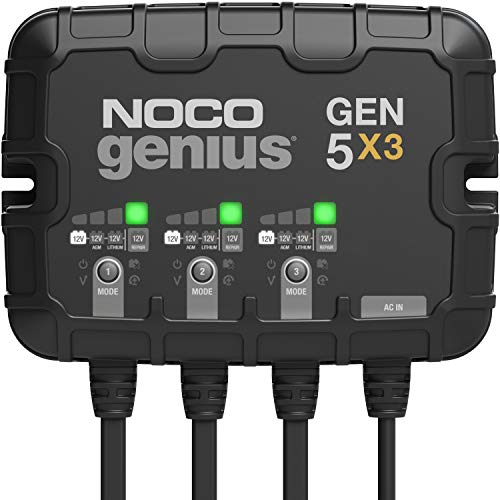
The GEN5X3 increases bank count to three while maintaining a total 15 amps, with each bank capable of delivering 5 amps. It supports 12V lead-acid, AGM, lithium, and specialized repairs. This model is engineered for marine environments with compact dimensions and robust performance, offering independent charging per bank for multi-battery systems on larger boats or those with crewed schedules requiring consistent battery maintenance.
NOCO GENPRO10X3: 3-Bank, 30A Smart Marine Charger
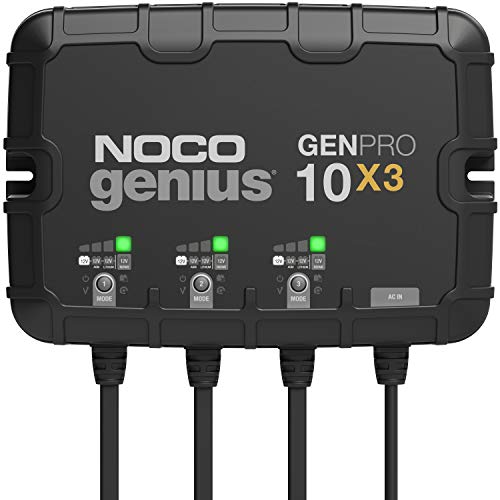
The GENPRO10X3 combines three banks for a total of 30 amps (10 per bank). It is designed for serious marine power, supporting AGM, LiFePO4, and deep-cycle batteries. Each bank operates independently with selectable modes, including a Repair Mode. The charger emphasizes compact size, rugged construction, and reliable performance in saltwater conditions, making it suitable for larger boats with diverse power needs.
Buying Guide: Key Considerations For Choosing A Boat Onboard Charger
When selecting an onboard charger, consider bank count, total amperage, and compatibility with your battery types. A higher bank count and total amperage are beneficial for boats with multiple batteries or lithium systems, but ensure the charger footprint fits your installation space. Look for IP-rated waterproofing (IP68 is common for marine use) to withstand splashes and spray. Choose models with temperature compensation to optimize charging in hot or cold climates, and with overcharge protection to extend battery life. Independent banking allows charging of different batteries with appropriate modes, which is valuable for mixed battery chemistries on modern boats. If you have dead or deeply discharged batteries, Force Mode or a similar feature helps restore charging. Finally, verify compatibility with your battery chemistry—including lead-acid, AGM, calcium, and LiFePO4—and confirm that the charger supports multi-bank operation without cross-interference. For boats with tight spaces, a compact or direct-mount design can simplify installation and reduce clutter in the bilge or cabin.
To help you compare, consider real-world usage: two-bank systems are common on smaller boats, while tr banks or more are typical for larger vessels or boats with high electrical demands. For anglers and cruisers, features like rapid desulfation, temperature compensation, and precise maintenance modes translate into longer battery life and fewer maintenance intervals. Safety features, including robust insulation and secure mounting, help ensure reliable operation in rough seas. Finally, verify that the charger’s construction and seals are appropriate for saltwater exposure and frequent vibration. By weighing these criteria, you can select a charger that balances performance, reliability, and installation practicality for your specific craft.