If you’re shopping for a car subwoofer amplifier, you want a model that delivers clean, powerful bass without distortion. This guide examines five solid options, highlighting who they’re best for and why each stands out. Perfect for enthusiasts upgrading a single sub or building a high-power system, these amps cover a range of power needs, efficiencies, and input options. Below is a quick summary of the five selected products to help you compare at a glance.
| Product | Best For | Key Benefit |
|---|---|---|
| Skar Audio RP-1200.1D | Powerful single-sub setups | 1,200W RMS @ 1Ω, on-board bass boost |
| BOSS Audio Systems R1100M | Compact builds with solid 1Ω capability | 1,100W max @ 2Ω, low/high inputs |
| AUDIOZERONE ZE1000.1 | Efficient high-load subs | 2,000W max, 1Ω stability, compact design |
| Skar Audio RP-350.1D | Budget-friendly single-sub power | 350W RMS @ 1Ω, bass boost |
| ORION Cobalt CBA2000.1D | Heavy-duty sub performance | 2,000W max, 500W RMS @ 1Ω |
Skar Audio RP-1200.1D Monoblock Amplifier
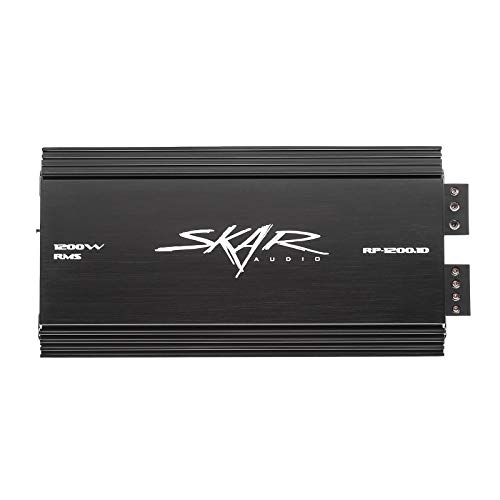
The Skar RP-1200.1D is a Class D monoblock amplifier designed for powerful subwoofer duty. It delivers 1,200 watts RMS at 1 ohm and up to 1,600 watts peak, making it suitable for a single high-demand sub. The on-board bass EQ switch offers +6 or +12 dB boost at 45 Hz, allowing quick tuning for tight bass response. Best for buyers prioritizing high RMS power in a compact form factor, with straightforward bass adjustments. A limitation to note is that performance claims depend on proper electrical and subwoofer matching in your installation.
BOSS Audio Systems R1100M Monoblock

The BOSS R1100M is a compact monoblock amplifier built for 1-ohm-friendly subwoofer systems. It provides 1,100 watts max at 2 ohms and features low pass filtering, a bass boost control, and both low and high-level inputs. This is best for smaller installs or users who want easy integration with factory radios. It may run warm at high volumes, so adequate ventilation is advised. It’s an attractive option when space and simple wiring are priorities.
AUDIOZERONE ZE1000.1 Monoblock

The AUDIOZERONE ZE1000.1 is a high-power Class D monoblock designed for 1 ohm loads with stability up to 1 ohm and a maximum of 2,000 watts. It offers a range of RMS values at different ohms, showing strong versatility for demanding subwoofers. The design emphasizes efficiency and compactness, making it suitable for tight installations. A potential limitation is the higher wattage output requiring careful electrical and sub wiring to avoid overheating in non-ventilated compartments.
Skar Audio RP-350.1D Monoblock

The RP-350.1D offers 350 watts RMS at 1 ohm and a 20 Hz to 250 Hz frequency response, plus the same convenient bass boost feature as the RP-1200.1D. This model is best for budget-conscious buyers who still want a capable monoblock for a single sub. It’s a good stepping stone toward higher-power setups, but its lower RMS rating means it won’t satisfy very demanding subs or multi-sub configurations.
ORION Cobalt CBA2000.1D Monoblock

The ORION Cobalt CBA2000.1D is a robust monoblock designed for heavy subwoofer loads, offering 2,000 watts max and 500 watts RMS at 1 ohm, with 1/2/4 ohm stability. It includes a MOSFET power supply and bass boost, plus adaptable low-pass filtering. Best for users who need substantial power for a single sub or a compact two-sub arrangement in more demanding listening environments. A limitation is that wire sizing and heat management become critical at higher volume levels.
Buying Guide
What power level do you actually need? Start by matching the amplifier’s RMS rating to your subwoofer’s rated continuous power. Oversizing can waste energy and generate excess heat, while undersizing can hamper bass control and headroom. If you run a single sub, a 350–1,000W RMS amplifier at 1 ohm is typically sufficient; for bigger subs or dual-sub setups, aim higher (1,200–2,000W RMS total placement across amplifiers).
Which impedance and stability matter? Most subwoofers thrive at 1 ohm or 2 ohms. Choose an amplifier that explicitly states 1-ohm stability if your sub is wired for tight, high-current performance. For flexibility, look for 1/2/4 ohm stability if you’re unsure of future upgrades or multiple subs.
What about efficiency and heat? Class D amps offer high efficiency, less heat, and smaller heat sinks—ideal for car environments. If you encounter space constraints or heat concerns, a compact Class D model with solid thermal protection is advantageous.
How important are inputs and remote controls? Low-level (RCA) inputs are standard for aftermarket head units, while high-level inputs simplify integration with factory radios. A remote bass/ sub control improves on-fly adjustment from the driving seat and is helpful in tuning bass response to different music genres and vehicle acoustics.
Is the amplifier’s build quality and protection important? Look for thermal, short-circuit, and overload protection. Modern mosfet power supplies improve efficiency and reliability, but protection circuits reduce the risk of damage to speakers or the vehicle’s electrical system during harsh bass bursts.
Practical comparison tips
- Best for sheer power: SKAR RP-1200.1D or AUDIOZERONE ZE1000.1 for higher wattage and aggressive bass.
- Better for compact installs: BOSS R1100M or ORION Cobalt CBA2000.1D due to robust power in smaller footprints.
- Budget-friendly but capable: SKAR RP-350.1D for a single sub with reliable performance.
Frequently asked questions
- What is RMS power and why does it matter? RMS power describes continuous power the amplifier can deliver, which better represents real-world performance than peak power.
- Do I need a separate bass remote control? A remote bass control helps tailor bass on the fly for different music styles and listening environments.
- Can I upgrade later with more subs? Yes, choose an amplifier with 1/2/4 ohm stability and sufficient total rms rating to support future upgrades.
- Is Class D always better for car audio? Class D is generally more efficient and generates less heat, which suits most car audio installations; however, ensure adequate cooling and good wiring.
- What about wiring and fuses? Use appropriate gauge speaker wiring and power wire according to the amplifier’s current draw; include a proper fuse in the power line near the battery.
Notes on compatibility and safety
All models listed are monoblock amps designed for subwoofers. Always verify subwoofer impedance, amplifier stability, and vehicle electrical capacity before installation. When mounting, ensure adequate ventilation and secure all wiring to prevent shorts or damage during driving.