If you rely on a vehicle to commute, work, or explore, a dedicated car battery monitoring system helps prevent unexpected failures. These devices track voltage, cranking performance, charging health, and even temperature or history data, so you know when maintenance is due. The top picks below are suited for different users: daily drivers who want smart alerts, RV or boat owners who need long-term monitoring, and DIY enthusiasts who value detailed metrics. A quick buyer snapshot is also provided to compare the five highlighted options.
| Product | Best For | Key Benefit |
|---|---|---|
| ANCEL BM200 | Multi-vehicle families | Bluetooth with alarm and trip history |
| ANCEL BM300 | Phone-led monitoring | Bluetooth with travel history and long-range app access |
| 12V Battery Tester (AILITRON) | RVers and boaters | Wireless 433MHz real-time monitoring |
| Renogy 500A Monitor | Precision measurement | High-accuracy shunt with alarms |
| CGELE DC Monitor | All-in-one display | Nine measurements in one LCD |
ANCEL BM200-US Car Battery Tester

The BM200-US is a 12V battery monitor and tester designed for cars, RVs, motorcycles, trucks, and boats. It tests voltage, cranking, and charging systems, and it records trip data with an abnormal alarm feature. Its value lies in real-time monitoring across multiple vehicles, making it a practical choice for households with several engines. The device supports location-related features when GPS is enabled, adding a layer of tracking for proactive maintenance.
Who it’s best for: drivers who want a comprehensive, multi-vehicle battery assistant with alerts and a history log. Why chosen: its broad compatibility and alarm system help prevent surprise battery failures. Limitation: GPS-related features require permission and may affect privacy and battery usage.
ANCEL BM300 12V Battery Monitor

The BM300 offers seamless Bluetooth monitoring with real-time data on voltage, cranking, charging health, and travel history. It can monitor a variety of vehicles and power systems, including solar setups, RVs, and boats. Its compact form makes it easy to install and keep attached, while the app delivers live metrics remotely. This model emphasizes long-range connectivity and continuous monitoring to catch early signs of battery issues.
Who it’s best for: vehicle owners who want quick phone-based access and proactive alerts. Why chosen: Bluetooth-enabled tracking from inside the car or at a distance is convenient. Limitation: Bluetooth connectivity may be affected by cold weather or obstacles, and the app can monitor only one device at a time.
12V Battery Tester Wireless Monitor (AILITRON)

This 12V monitor emphasizes real-time battery health, temperature, voltage, and charging status, with a wireless 433MHz link. It’s particularly suitable for car, RV, boat, and golf cart applications where a hands-off display and continuous data are valued. A notable strength is its wireless transmission that reduces wiring clutter while maintaining timely status alarms.
Who it’s best for: users who want wireless data transmission and a straightforward setup. Why chosen: real-time health and temperature data are helpful for seasonal storage or frequent use. Limitation: wireless reliability can be influenced by obstacles or distance beyond the supported range.
Renogy 500A Battery Monitor With Shunt
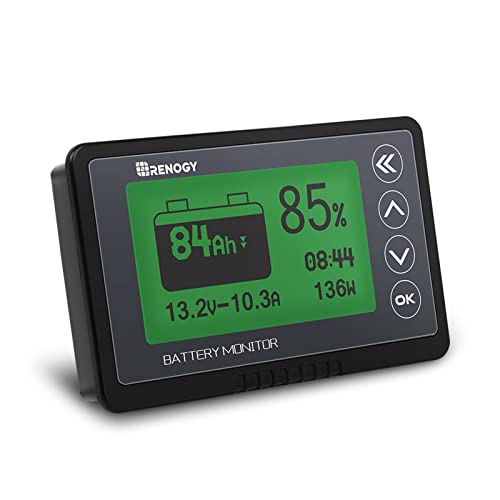
The Renogy monitor uses a shunt-based design to deliver high-precision voltage and current readings. It supports high and low voltage alarms, increasing battery protection. Compatible with a wide range of 12V and higher systems, including lead-acid, lithium, and AGM types, it is a solid choice for users who want precise measurements and robust protection against deep discharge.
Who it’s best for: enthusiasts who need accurate, long-term monitoring with reliable alarms. Why chosen: chokes down potential battery damage with clear high/low alarms and backlight visibility. Limitation: shunt-based systems may require careful installation to ensure accuracy and wiring integrity.
CGELE DC Multifunction Battery Monitor

The CGELE monitor is designed to display nine measurements on a single LCD interface, including voltage, current, power, impedance, internal resistance, capacity, SOC, energy, and running time. Its wide voltage range (0-200V) and 0-100A current capacity make it versatile for cars, RVs, solar setups, and larger battery banks. The 360° backlit display ensures readability day or night.
Who it’s best for: users who prefer a comprehensive, all-in-one readout with a single screen. Why chosen: the multi-parameter display helps compare several metrics quickly. Limitation: installation may be more involved due to the broad measurement set and wiring needs.
Buying Guide: How to Choose a Car Battery Monitor
- Measurement scope: Decide whether you need voltage and crank-only metrics or a full suite including charging health, temperature, SOC, and energy usage.
- Connectivity: Bluetooth, wireless 433MHz, or wired connections affect how you access data. Consider range, app reliability, and your preferred monitoring location.
- Power draw and installation: Some monitors stay connected continuously and may have low current draw. Check installation complexity and whether a shunt is required.
- Battery compatibility: Verify compatibility with leading battery chemistries (lead-acid, AGM, GEL, lithium). Ensure the monitor supports your system’s voltage and capacity.
- Alarms and alerts: Look for high/low voltage, cranking health, charging faults, and abnormal temperature alarms to prevent failures.
- Display and visibility: A clear LCD or app-based readout is essential for quick assessments, especially in varying lighting conditions.
- Mobile access: If you want remote monitoring, consider whether the device supports location tracking or multi-vehicle management without intrusive permissions.
Frequently Asked Questions
- What is a battery monitor and why do I need one? A battery monitor continuously tracks key metrics such as voltage, current, and health to alert you to potential failures before they occur, saving time and avoiding breakdowns.
- Do I need a shunt-based monitor? Shunt monitors provide higher accuracy for current measurement, which is useful for precise energy management in larger systems.
- Can monitors track multiple vehicles? Some models support multiple vehicles or travel history, but many are designed for a single device at a time. Check device specifications for multi-vehicle use.
- Does Bluetooth monitoring require a smartphone app? Yes, Bluetooth-enabled monitors typically pair with a mobile app to display real-time data and alerts.
- Will a monitor drain my battery? Most modern monitors are designed to minimize power draw, but always check the device’s stated current consumption to ensure it meets your needs.
- Can I install these myself? Many monitors install with basic wiring to the battery terminals or a dedicated harness. Follow the manufacturer’s installation guide for best results.