Find the right wheel alignment machine for your needs—from professional shops to serious DIYers. This guide highlights five capable options, explains who they suit best, and compares key features like accuracy, database size, and ease of use. Each entry includes practical cautions to help you choose wisely.
Buyer profiles:
– Professional shop owners: prioritize accuracy, robust data, and durable construction.
– Serious DIY enthusiasts: value ease of use, clear indicators, and reasonable databases.
– Fleets or multi-vehicle users: look for strong databases and reliable repeatability.
Summary table of selected products:
| Product | Best For | Key Benefit |
|---|---|---|
| AUTOOL XC503 | Professional shops and experienced DIYers | High precision, voice guidance, data traceability |
| AUTOOL XC505 | Shop settings with large vehicle database | Waterproof target, global database, quick model lookup |
| HayWHNKN 3D Wheel Alignment Machine | Busy shops needing fast setup | Real-time 3D measurement, ready-to-use |
| PICURA Wheel Alignment Tool Kit | DIY and home use | Caliper removal not required, precise measuring tapes |
| VEVOR Wheel Alignment Turn Plates | Home garages and light-duty fleets | Two plates, high load capacity, clear angle scales |
AUTOOL XC503 3D Wheel Alignment Machine

The XC503 uses high-precision data reception and eliminates cable dragging by wireless signaling. It provides voice-guided operation and LED indicators to simplify alignment workflow. It supports traceable test data, including detailed vehicle parameters, and can print the history and current reports for record-keeping.
Best for: Independent shops and professional DIYers who need precise results with printed documentation. Limitations: May require ongoing software updates to keep the database current.
AUTOOL XC505 3D Fully Automatic Wheel Alignment Machine

The XC505 features a waterproof, fall-resistant target and a global database with more than 100 brands and 50,000 models. It supports rapid brand and model selection, plus built-in shunting help for quick adjustment schemes. Data traceability and reporting are included for record-keeping.
Best for: Shops handling a broad range of vehicles and users who value a large, searchable vehicle database. Limitations: Higher complexity may require some training for best results.
HayWHNKN 3D Wheel Alignment Machine

HayWHNKN emphasizes intelligent 3D measurement with real-time data on camber and toe. It ships ready to use, with cameras and sensors designed for quick setup. The machine supports a broad vehicle specification library (up to 60,000 models) for versatile use across many vehicles.
Best for: Shops and DIYers who want fast setup and a large vehicle database. Limitations: The on-board software may require occasional updates to access new models.
PICURA 2026 Upgraded Wheel Alignment Tool Kit

The 2026 kit includes two toe alignment tool plates and two measuring tapes, with caliper removal not required. It uses two 16.4-foot tapes for 1/32-inch precision, offering fast, accurate toe measurements and improved stability. Durable construction supports extended use.
Best for: DIY enthusiasts and hobbyists who prefer a simple, direct approach to toe alignment without disassembling brakes. Limitations: Not a full vehicle alignment system; best used with basic alignment objectives.
VEVOR Wheel Alignment Turn Plates (4-Ton)
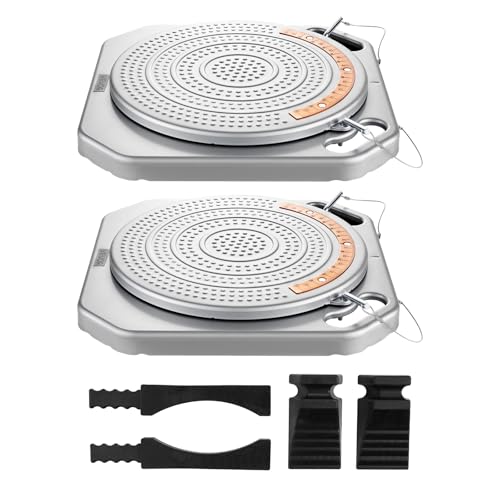
These turn plates provide low-friction rotation to support precise toe and camber measurements. Each plate carries heavy-load capacity up to 2 tons per plate and includes transition bridges and chocks for easy drive-on access. Brass dial angle scales enable quick, readable adjustments.
Best for: Home garages and light-duty fleets needing stable, repeatable plate-based alignment. Limitations: Suitable primarily for static plate-based alignment; not a full machine system.
VEVOR Digital Toe & Camber Alignment Plates (2 Pc)
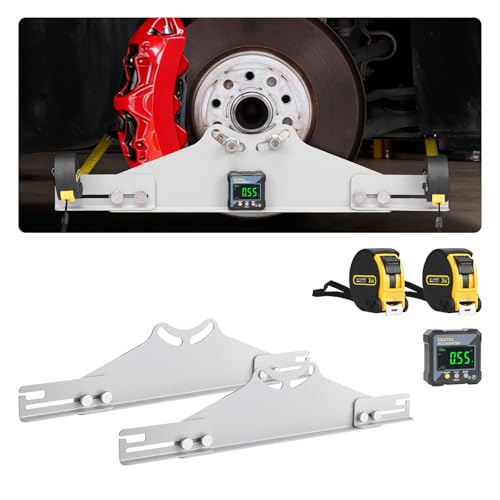
These two-plate tools set features a magnetic digital angle gauge with 0.2° accuracy for precise camber and toe assessment. An adjustable length range supports sedans, trucks, and SUVs. Rugged construction ensures durability and consistent readings.
Best for: Users who want a portable, precise toe and camber measurement setup without a full alignment rack. Limitations: Might require a compatible calibration routine for consistent results across vehicles.
Zackman Scientific AutoSolo 3-in-1 Magnetic Gauge

This 3-in-1 tool measures camber, caster, and kingpin inclination, offering a magnetic mounting system for quick placement on wheels or brake discs. It’s compatible with hubs and brake discs and can pair with adapters for broader use.
Best for: Quick, front-end alignment checks and mobile use. Limitations: Designed for independent measurements rather than full front-end alignment workflows.
Buying Guide
- What type of system do you need? Choose between full 3D wheel alignment machines (XC503, XC505, HayWHNKN) and plate-based tools (VEVOR, PICURA, XIEKRAB, Zackman) based on your workflow and vehicle range.
- Database depth and vehicle compatibility: A larger database speeds model selection and reduces manual entry. If you work with many brands, a system with 50,000+ models is advantageous.
- Ease of use vs. precision: 3D machines emphasize guided operation and data printouts. Plate tools emphasize portability and low cost but may require more manual input.
- Data recording and reporting: Print or export vehicle alignment data to maintain records. This is valuable for shops and fleets for quality control.
- Durability and maintenance: Waterproof targets and durable hardware improve reliability in busy environments. Consider whether you need professional service options.
FAQ
- What is the difference between a 3D wheel alignment machine and a plate-based tool?
Answer: A 3D machine measures wheel angles with sensors and software for full alignment data, while plate tools offer basic toe/camber measurements using manual or tape-based readings. - Do these devices require calibration?
Answer: Most 3D systems include calibration routines; plate tools may require occasional calibration checks to ensure accuracy. - Can these tools work on trucks and SUVs?
Answer: Yes, but model availability and plate size may determine fit. Check the device manual for compatible vehicle classes. - Is a large vehicle database essential for DIY use?
Answer: Not strictly essential, but it speeds up model selection and reduces guesswork, especially for multiple vehicle types. - What should I consider when choosing between a full machine and plates?
Answer: Consider budget, space, vehicle variety, and whether you need documented reports or simply quick alignment checks. - Are there safety considerations for alignment work at home?
Answer: Yes—use proper wheel chocks, follow tool instructions, and work with wheels securely supported on a stable surface.