Answer: For travelers and daily commuters who need reliable, portable charging options, these five Amazon-listed EV chargers offer flexible levels, compatibility, and safety features to keep you powered on the move. The top picks balance speed, weather resistance, and broad vehicle compatibility. Best for road trips, work commutes, and backup charging at destinations, each product targets different user needs—from universal J1772 compatibility to Tesla adapters and dual-voltage portability. The summary table below helps you compare core specs at a glance.
| Product | Best For | Key Benefit | Limitations |
|---|---|---|---|
| AMPURE Go 1 Portable Level 2 EV Charger | All EVs & PHEVs, indoor/outdoor use | 32A Level 2 charging, 20 ft cable, weatherproof | Requires proper outlet; some vehicles may need adapter |
| FOCSPROD J1772 to Tesla Charger Adapter | Tesla owners needing J1772 options | Adds J1772 charging to Tesla, up to 80A | Not for Tesla Superchargers |
| AIMILER Level 2 EV Charger | Smart app control fans of adjustable current | 32A, 25 ft cable, ETL certified | Some models may require adapters for Tesla |
| eTimxon 16A Dual-Mode Charger | Versatile Level 1 & 2 charging | 16–32A, 25 ft cable, dual plugs | Not all configurations suitable for all outlets |
| FOCSPROD Tesla to J1772 Charger Adapter | Expands charging options across networks | 60A up to 250V, broad compatibility | Not compatible with DC fast charging |
AMPURE Go 1 Portable Level 2 EV Charger
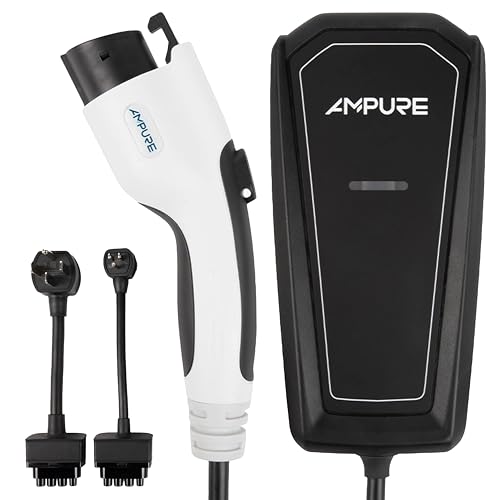
The AMPURE Go 1 is a 32A Level 2 charger with a NEMA 14-50 plug and a 20-foot cable. It supports 120V (Level 1) and 240V (Level 2) charging, offering flexibility for home, travel, or workplace use. It is UL and Energy Star certified, with IP67 weather resistance and built-in safety protections. Best for: drivers who want a rugged, all-weather charger that works at home, on the road, or at destination charging stations. Caution: Ensure you have a compatible 240V outlet and appropriate adapters for specific EVs when needed.
Why selected: Its combination of weatherproof design, universal SAE J1772 compatibility (with adapters for some models), and dual-voltage capability makes it a solid all-around choice for travelers and daily drivers alike. It’s particularly well-suited for outdoor parking or garage setups where exposure to elements is a concern.
FOCSPROD J1772 to Tesla Charger Adapter
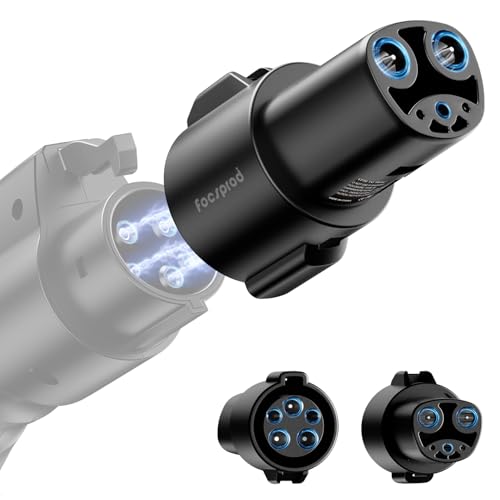
This adapter converts J1772 charging to a NACS/Tesla-compatible format, enabling Tesla vehicles to access non-Tesla charging infrastructure where a J1772 port is available. Best for: Tesla owners seeking broader charging options beyond Tesla-branded networks. Caution: Not compatible with Tesla Superchargers or DC fast charging; charging speed depends on the host station’s capabilities.
Why selected: It adds network flexibility for Tesla owners, broadening charging access while maintaining UL 2252 safety standards. Choose this if you want more compatibility without replacing your existing charger setup.
AIMILER Level 2 EV Charger

The AIMILER charger offers 32A Level 2 charging with a 25-foot cable and Wi-Fi app/plug-and-play setup. It supports 240V NEMA 14-50P and a J1772 connector, making it broadly compatible with North American EVs. Best for: tech-minded buyers who want app control and adjustable amperage to optimize charging at home or on the road. Caution: Some Teslas require a J1772 to Tesla adapter for full compatibility.
Why selected: Its app-driven control and factory ETL certification provide a practical balance of convenience and safety. Use this if you value remote monitoring and adjustable charging settings for off-peak use.
eTimxon 16A Portable Level 1&2 EV Charger

The eTimxon dual-mode charger supports 240V Level 2 with a fixed NEMA 6-20 plug and Level 1 with a NEMA 5-15 adapter. It delivers up to 32A on Level 2 with 25 feet of cabling, making it flexible for both home outlets and road-side charging. Best for: users who need a single device that covers both Level 1 and Level 2 charging scenarios. Caution: Some cars may default to lower amperage when using the 5-15 adapter, so monitor current settings manually.
Why selected: The dual-plug design reduces the need for multiple chargers while maintaining safety standards. Choose this if you want a compact, versatile charger for mixed-use scenarios.
eTimxon 16A Level 1&2 EV Charger (Alternative)
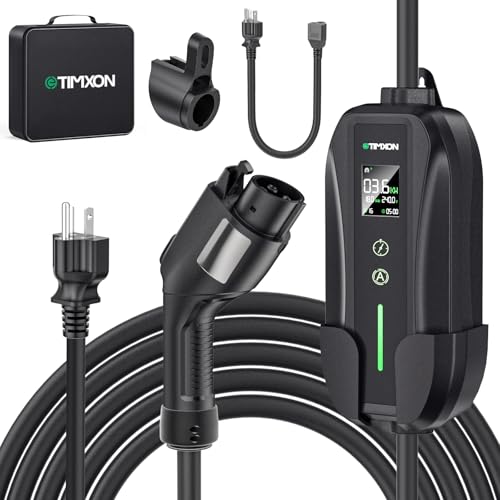
This alternative eTimxon listing emphasizes 16A Level 2 charging with identical dual-voltage capability as the other model, including a 25-foot cord and NEMA 6-20P plug. Best for: travelers who want a reliable, portable backup charger that’s easy to install. Caution: Verify your vehicle’s compatibility with the 6-20 configuration and any adapters needed for Level 1 scenarios.
Buying Guide: Key Points For On-The-Go EV Charging
- Vehicle compatibility: Ensure the charger supports your EV’s charging standard (J1772 vs. NACS) and power requirements (amps, voltage).
- Voltage and amperage: Dual-voltage or Level 2-capable models offer faster charging, but require compatible outlets and circuit capacity (30A–40A ranges common).
- Portability vs. power: Larger cords and higher amperage deliver faster charging but reduce compactness. Balance needs with travel plans and outlet availability.
- Safety certifications: Look for UL, Energy Star, or ETL listings and IP ratings for weatherproof use outdoors or in variable conditions.
- Connectivity features: App control, firmware updates, and smart scheduling can optimize charging efficiency and energy management.
- Adapter needs: For non-Tesla drivers, ensure availability of J1772 adapters or Tesla adapters where necessary, and verify compatibility with host charging stations.
- Installation considerations: Some devices require professional installation for high-amperage outlets; others are plug-and-play with standard outlets.
Frequently Asked Questions
- Can I charge an EV with a portable charger at a public charging station? Yes, if the charger uses a compatible connector and the station supports the charger’s voltage and amperage.
- Is a higher amperage charger always better for travel? Higher amperage provides faster charging but requires compatible outlets and circuit capacity at your stops.
- Are portable EV chargers weatherproof? Many models are rated for indoor/outdoor use with IP ratings; check the product’s specifics before outdoor deployment.
- What safety features should I look for? Look for over/under voltage protection, overheating protection, surge protection, and built-in GFCI on portable units.
- Can I use Level 1 charging on the road? Yes, many portable units support Level 1 charging via standard outlets, which is slower but useful when higher power isn’t available.