Answering the needs of automotive hobbyists and professional painters alike, these HVLP turbine spray guns deliver controlled atomization, reduced overspray, and smooth finishes on automotive projects. The top picks below are best for car refinishing, priming, and detailed panel work. Each product highlights who benefits most and why it’s a strong choice for automotive work.
| Product | Best For |
|---|---|
| PHALANX 3 Stage HVLP Paint Sprayer | Best for versatile paints and furniture-to-auto projects |
| Fuji Spray 2805-T75G Mini-Mite 5 Platinum | Best for professional-grade finishes on small to medium panels |
| Apollo Sprayers HVLP Power-5 VS Automotive | Best for self-contained, compressor-free operation |
| E7050 Non-Bleed Turbine Spray Gun | Best budget-friendly non-bleed option for basic finishes |
| InoKraft D1 LVLP Spray Gun Kit | Best for DIYers wanting a complete starter kit |
The following sections detail each product’s strengths, who should buy, and important limitations to consider. Use this guide to compare options quickly and choose the best match for your automotive project.
PHALANX 3 Stage HVLP Paint Sprayer

Features include a powerful 3-stage turbine delivering about 7.5 PSI, adjustable spray pattern with a pattern control knob, and compatibility with water-based and solvent paints. This makes it suitable for auto refinishing, furniture, and cabinets. Best for: hobbyists and small shops seeking a versatile, all-purpose spray gun that handles latex, urethane, enamel, and primers. Limitation: higher-output models may require careful parameter tuning to avoid flutter on ultra-thin coatings.
Fuji Spray 2805-T75G Mini-Mite 5 Platinum

This 5-stage turbine system delivers high atomization with a 9.5 PSI output and includes a Heat Dissipation Chamber for cooler operation. The professional spray gun features a side pattern control knob to adjust fan size from small to large. Best for: painters needing consistent, high-quality finishes on automotive panels and primers. Limitation: advanced control may require experience to optimize for specific coating types.
Apollo Sprayers HVLP Power-5 VS Automotive
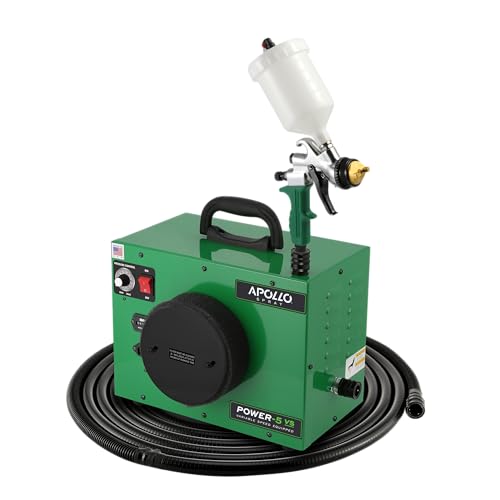
No external air compressor is needed—the turbine is self-contained with a 100% duty cycle. It uses a 5-stage turbine for strong atomization and offers a patented variable speed pressure control from 0.1 to 9.5 PSI. Best for: garages and shops seeking a reliable, compressor-free solution for fine finishes and high-build primers. Limitation: the unit may be heavier than handheld, non-turbine models for prolonged sessions.
E7050 Non-Bleed Turbine Spray Gun

Non-bleed design reduces compressor-induced overspray, and it includes an 8-ounce cup. It’s compatible with various turbine systems from brands like Fuji, WAGNER, TITAN, APOLLO, and GRACO. Best for: beginners or light-touch automotive refinishing where simplicity and clean air supply are priorities. Limitation: may have less atomizing power for heavy, high-build primers or gel coats.
InoKraft D1 LVLP Spray Gun Kit

Designed for easy use with clearly marked scales and a quick-start setup, the kit includes multiple nozzle options and regulators. Best for: DIYers and hobbyists who want a complete starter kit for automotive and furniture painting. Limitation: LVLP technology typically prioritizes transfer efficiency over heavy-duty primer application; thicker coatings may require thinning or multiple passes.
Buying Guide
What should you consider when choosing an HVLP turbine spray gun for automotive work?
- Spray pattern control: Look for adjustable patterns (round to wide fan) for precision on panels and larger surfaces.
- Turbine power and PSI range: Higher PSI helps with thicker paints; ensure the unit supports your material (urethane, enamel, primers).
- Air source and convenience: Whether you prefer a self-contained turbine or a system compatible with an external compressor affects setup and portability.
- Material compatibility: Confirm whether water-based or solvent-based paints are supported and whether thinning is required.
- Weight and ergonomics: Heavier guns can cause fatigue during long sessions; consider handle design and balance.
- Maintenance: Look for features that simplify cleaning, such as easy-to-disassemble cups and air passages.
- Budget and future-proofing: A higher-end system may offer better atomization and durability for ongoing auto refinishing.
FAQ
- What is an HVLP turbine spray gun best used for in auto work?
– Best used for priming, base coats, and clear coats with reduced overspray and improved transfer efficiency. - Do I need an external compressor with turbine HVLP guns?
– No. Turbine systems are self-contained and designed to avoid contamination from external air sources. - Is non-bleed or bleed better for automotive finishes?
– Non-bleed designs generally reduce overspray and are common in automotive refinishing; bleed designs can provide more consistent air output for certain coatings. - Can I use lacquer or enamel with these sprayers?
– Most listed units support common automotive coatings when thinned and filtered per product guidelines. - Which product is best for a beginner?
– The InoKraft D1 LVLP kit is designed for easy setup and includes multiple nozzle sizes and accessories for new users. - What should I avoid when using HVLP for autos?
– Avoid spraying at too high a pressure for thin coatings; ensure proper ventilation and respiratory protection.