When choosing an RV water pressure pump, the goal is consistent flow, reliable priming, and a unit that matches your power source. This guide highlights five practical options for American RV owners, campers, and boats. Each product is evaluated for best-suited buyers, including off-grid travelers, full-time RVers, and weekend campers. A quick buyer table follows to help you compare key specs at a glance.
| Product | |||||
|---|---|---|---|---|---|
| SEAFLO 33 Series | AC | 3.3 | 45 | AC | RVs, boats, cabins needing NSF/UL-compliant potable water |
| ECO-WORTHY 33-Series | AC | 4.0 | 45-70 | 110V | Quiet, auto on-demand pressure with high flow |
| Gidrox 12V RV Water Pump | 12V DC | 4.0 | 45 | 12V | Off-grid, low-noise operation |
| Upgraded 12V RV Water Pump (Kitvance) | 12V DC | 6.0 | 70 | 12V | High-flow, quiet operation for multiple fixtures |
| Tdrsuper 110V AC Booster | AC | 5.5 | 70 | 110V | Home kits, RVs needing strong boost with auto control |
SEAFLO 33 Series 3.3 GPM 45 PSI Pump

The SEAFLO 33 Series delivers 3.3 GPM at 45 PSI with self-priming capability. It is designed for RVs, caravans, boats, and industrial use, meeting NSF/ANSI/CAN 61 & 372, NSF 24, and UL 778 standards. The unit is backed by a four-year warranty. Best for buyers prioritizing potable-water safety compliance and a proven, long-term motor. Choose this if you need a dependable, certified pump with a solid warranty and NSF compliance. A potential limitation is the fixed 45 PSI shut-off, which may not suit very high-demand multi-fixture setups in larger rigs.
ECO-WORTHY 33-Series 4.0GPM 50PSI AC Pump
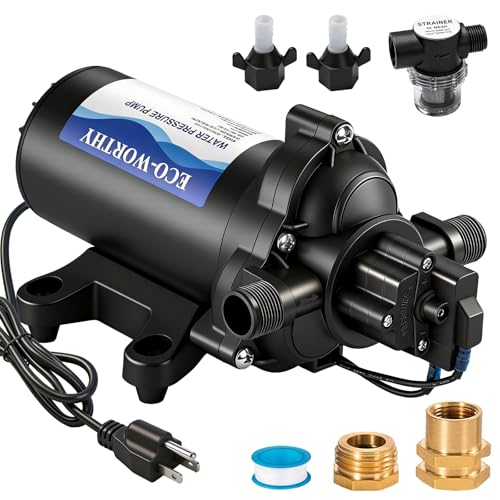
This ECO-WORTHY diaphragm pump runs on 110V AC and provides up to 4.0 GPM at 50 PSI, with a smart pressure switch that turns on when faucets open and off when closed. It is self-priming up to ~9.8 feet and can lift water up to 131 feet. An auto-overload protection feature adds safety, and the adjustable pressure range is 45–70 PSI. Best for campers who want a quiet, on-demand pump that doesn’t require a marine battery. Better for systems with moderate pressure needs and higher peak flow than some 3.0 GPM models. A caveat: it relies on AC power and may require shore power or a generator in remote boondocking.
Wassermann 12V RV Water Pump Kit (4.0 GPM, 45 PSI)

The Wassermann 12V kit includes the pump, hoses, debris filter, and adapters. It provides up to 4 GPM at a steady 45 PSI and supports standard 12V battery operation, with simple wiring for RVs and boats. Best for buyers who want an all-in-one kit with fittings included. It’s a solid choice for those seeking straightforward installation and reliable daytime use. A potential limitation is the need for a compatible 12V power source and proper wiring for peak performance.
Upgraded 12V RV Pump, 7GPM 70PSI (Kitvance)

This 12V pump delivers 7 GPM at up to 70 PSI with a five-chamber diaphragm and automatic pressure switch. It is designed for high-demand RVs or boats with multiple fixtures. Best for buyers needing strong flow for showers and multiple outlets, and who can accommodate a higher current draw. It is run-dry safe and uses NSK bearings for quiet operation. A limitation is the higher current requirement and potential need for robust electrical wiring in older RVs.
Tdrsuper 110V Booster Pump with 5.5GPM

The Tdrsuper unit provides 5.5 GPM at a default 70 PSI with automatic start/stop. It offers self-priming up to 9.8 feet and a lift up to 164 feet, along with overload and overheat protection. It supports dry-running, and includes anti-vibration features. Best for buyers who want a strong boost in pressure for RV kitchens and baths. Avoid if you need ultra-quiet operation in a compact space, as it can be louder than some diaphragm-only models.
Buying Guide: Key Purchase Considerations
- Power source compatibility: Choose AC models if you have constant shore power; pick 12V DC models for off-grid RV setups.
- Flow rate vs. pressure: Higher GPM is better for multiple fixtures; higher PSI is preferable for long pipe runs or heavy-use showers.
- Self-priming capability: Look for units that prime quickly and lift water from tank to fixture, especially if the tank is at a distance or low.
- Automatic pressure switch: An auto on/off switch reduces cycling and extends pump life while keeping water pressure steady.
- Material and safety features: Corrosion resistance, thermal overload protection, and run-dry safety protect the pump in variable RV conditions.
- Certifications and warranty: NSF/UL certifications can matter for potable-water systems; longer warranties offer peace of mind for frequent travelers.
FAQ
- What is a typical RV water pump PSI range?
Most RV pumps operate between 45 and 70 PSI, with many models offering adjustable range within that band. - Do I need an AC or 12V pump for my RV?
Choose based on your power setup. AC pumps work where shore power is available, while 12V pumps are preferred for off-grid use with a battery system. - Can I run a pump dry without damage?
Some pumps are rated run-dry safe, but always follow manufacturer guidelines; continuous dry operation can shorten pump life. - Is NSF certification important for RV water pumps?
NSF/UL certifications ensure compliance with potable-water safety standards, which is beneficial for drinking-water systems. - What’s the advantage of a multi-chamber diaphragm pump?
Multi-chamber designs reduce pulsation, provide smoother flow, and can offer quieter operation in tight RV spaces. - How do I choose between a kit vs. a standalone pump?
Kits with hoses, adapters, and debris filters simplify installation, while standalone pumps offer flexibility for upgrades.