Answering the need for accurate, reliable leak detection in automotive air conditioning systems, these SAE J2913-compliant detectors help technicians and DIYers identify leaks quickly. The best picks balance sensitivity, durability, and ease of use for both professional shops and home users. This guide highlights top models, who they’re best for, and practical buying tips.
Buyer summary table (selected products):
| Product | Best For | Key Benefit |
|---|---|---|
| Elitech ILD-200 | Professional shops needing long sensor life | Infrared sensor with high sensitivity and broad halogen gas range |
| Mastercool 55900 Intellasense II | R134a and R1234yf compliance with compact design | Heated tin oxide sensor, SAE standards certified |
| Robinair LD7 | Detailed leak pinpointing for automotive A/C | Color display with bar graph and sweep modes |
| Wale&Morn LD200 | All-round refrigerants with long life | Advanced heated diode, EN14624, SAE compatible |
| Elitech WJL-6000S | Versatile halogen gas detector for R22/R410A/R134A | All halogenated gas detection with adjustable sensitivity |
Elitech ILD-200: Infrared Leak Detector
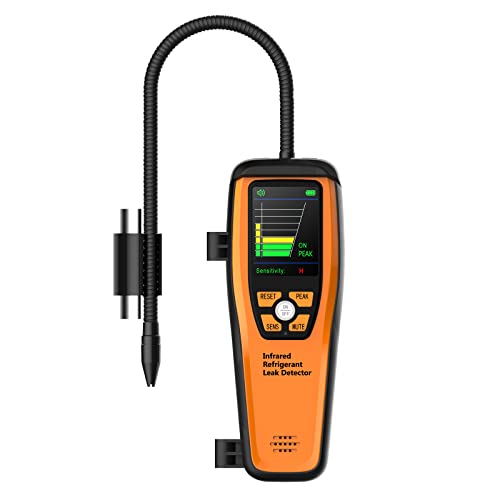
The ILD-200 uses an infrared sensor with strong anti-interference properties and a fast response time. It offers adjustable sensitivity with High/Medium/Low levels, with a maximum sensitivity up to 0.14 oz/yr. It detects all halogenated refrigerants including CFCs, HFCs, HCFCs, HCs, HFOs, and common blends. Best for technicians needing durable performance and broad refrigerant coverage. A potential limitation is reliance on infrared sensing, which may be affected by environmental factors in extreme conditions.
Mastercool 55900 Intellasense II

This detector uses a heated tin oxide sensor that detects all refrigerants with high sensitivity and fast response. It is certified to SAE J2791 (R134a) and J2913 (R1234yf) standards and features a Super Sensitive mode for small leaks, including R1234yf and R407C. Best for service techs who need certified performance in compact form. A noted limitation is the requirement to operate in a controlled environment for optimal sensitivity in some scenarios.
Robinair LD7 Premium Leak Detector

The LD7 offers a color graphic display that shows leak size via bar graph and sweep modes. Bar graph mode shows refrigerant concentration in real time as the sensor nears a leak, while sweep mode provides a line graph to trace the source. Best for technicians who need intuitive visualization to pinpoint leaks quickly. Limitation: some users may prefer alternative alert intensities in noisy shop environments.
Wale&Morn LD200

LD200 features an advanced heated diode sensor with long life and strong interference resistance. It detects all halogenated refrigerants and conforms to EN14624 and SAE J2791/J2913. It has a user-friendly five-key design, LCD status indicators, and rechargeable power. Best for users who want a robust, portable detector with clear status feedback. A limitation is the battery life claim may vary with usage patterns.
Elitech Freon Leak Detector, WJL-6000S

WJL-6000S detects all halogenated refrigerants with a wide range of gases and provides clear audible and visual indicators. It is designed for HVAC/R techs working with R22, R410A, R134A, and related blends. Best for shops needing broad gas coverage in a single detector. Limitation: may require occasional calibration to maintain peak sensitivity.
TOPTES RT-389

TOPTES RT-389 offers three sensitivity modes and alarms (sound, visual, vibration) with a curved funnel chart and trend-tracking display. Best for users who need flexible signaling and clear trend analysis in automotive HVAC tasks. Limitation: some users may prioritize faster warm-up times for quick checks.
Buying Guide
What sensor type should I choose?
Infrared sensors detect a wider range of halogenated gases with quick responses, while heated diode sensors offer strong resistance to interference and long life. For J2913-focused work, infrared and heated diode options both provide solid performance; consider a detector that covers R134a, R1234yf, and common blends.
How important is SAE/J SAE compliance?
SAE J2791 and J2913 compliance ensures the detector meets standardized leak detection methods used in automotive A/C systems. Choose models explicitly listing these standards to ensure compatibility with workshop protocols and maintenance procedures.
What sensitivity range is ideal?
Higher sensitivity helps detect smaller leaks but can increase false alarms in busy environments. Look for adjustable sensitivity so you can tailor detection for different system pressures and ambient conditions. Common ranges span from 0.03 to 0.21 oz/yr depending on model.
What features improve usability?
Visual and audible indicators, data display (bar or line graphs), peak hold, and easy-to-read LCD screens help technicians locate leaks faster. A longer probe and ergonomic design improve access to tight spaces in vehicles.
Battery life and portability
Rechargeable batteries with practical runtime (several hours) are valuable for field work. Consider devices with Type-C or other modern connectors for quick charging and reliable operation away from outlets.
Certification and reliability considerations
Beyond SAE standards, look for EN14624 and other certifications if your work spans different regions or regulatory environments. A robust build, warranty, and documented sensor life contribute to total cost of ownership.
FAQ
- What gas can a SAE J2913 detector find? It detects halogenated refrigerants, including CFCs, HFCs, HCFCs, HFOs, and mixed blends such as R11, R22, R404A, and R410A.
- Is a higher sensitivity detector always better? Not always. Higher sensitivity helps in small leaks but may increase false alarms in busy environments. Choose a model with adjustable sensitivity.
- Do I need certification on my leak detector? Yes, SAE J2791/J2913 certification aligns with industry standards and improves reliability for automotive service work.
- Which detector is best for beginners? A model with clear visual indicators, a simple user interface, and safety features is ideal. Robinair LD7’s graphical displays are helpful for new users.
- Can these detectors work with R1234yf systems? Yes, many listed models specifically mention R1234yf compatibility as part of their certified or broad gas detection range.