Choosing the right six-volt golf cart battery ensures dependable performance, longer life, and smoother rides on the course or in your utility fleet. This article highlights five top picks that fit standard GC2 configurations, with a mix of deep-cycle lead-acid and high-capacity options. Each product section includes key specs to help you compare suitability for your golf cart, RV, solar setup, or commercial application.
style=”font-weight:bold;”>Summary Table
| Product | Brand | Voltage / Type | Capacity (Ah) |
|---|---|---|---|
| US1800XC2 (6V GC2) | U.S. Battery | 6V Flooded Lead Acid | 208 Ah |
| PowerStar Crown GC2 6V | PowerStar | 6V Flooded Lead Acid | 220 Ah |
| US2000-XC2 6V | U.S. Battery | 6V AGM Lead Acid | 220 Ah |
| ML230-6GC2-6V | Mighty Max Battery | 6V SLA/AGM | 230 Ah |
| Banshee T875 8V | Trojan Battery Company | 8V Flooded Lead Acid | 170 Ah |
Notes: The table includes five options with a focus on six-volt configurations (GC2 format) where possible. The Trojan Banshee T875 is included as a comparative option for users open to an 8-volt setup. Always verify compatibility with your cart’s wiring and charger before purchasing.
US1800XC2 6V Deep-Cycle Battery (208Ah)

Product features: BCI Group GC2, Voltage 6V, Type Flooded Lead Acid. This six-volt model emphasizes deep-cycle performance suitable for golf carts, solar storage, and marine or RV use. The GC2 format pairs with common four-terminal battery racks, facilitating straightforward installation and easy replacement for older GC2 banks.
PowerStar Crown GC2 6V 220Ah Deep Cycle

Product features: 6V, 220Ah, designed as a replacement for Trojan T105 in GC2 configurations. This battery is suitable for golf carts, solar power banks, and RV house systems. It weighs about 60 lbs and uses standard GC2 dimensions, making it a practical upgrade for deep-cycle needs with robust cycle life.
US2000-XC2 6V 220Ah AGM Battery
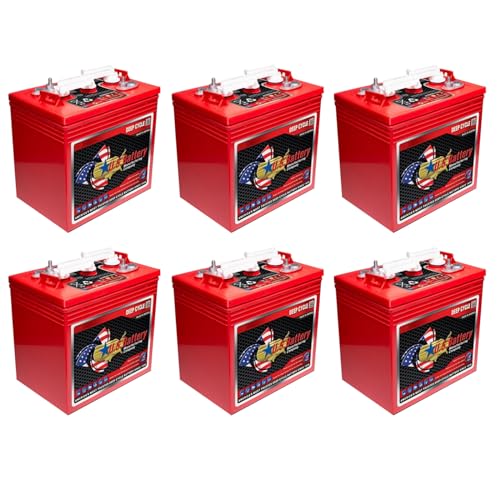
Product features: 6V, 220Ah, AGM chemistry. The AGM format provides maintenance-free operation and better spill resistance compared to flooded options. This makes it a strong choice for golf carts used in varying climates and for storage in RVs, solar setups, or backup power systems where low-maintenance operation is valued.
ML230-6GC2-6V 230Ah Mighty Max Battery

Product features: 6V 230Ah, dual-terminal SLA/AGM battery with maintenance-free design. The Mighty Max ML230-6GC2 variant emphasizes deep-cycle performance and compatibility with wide operating temperatures, suitable for golf carts, solar storage, and backup power for small to mid-size applications.
Banshee T875 8V Deep-Cycle Battery

Product features: 8V, 170Ah, deep-cycle flooded/wet lead-acid. While not a 6V battery, the T875 remains a common replacement in golf carts that operate on 8V packs. It can be integrated into GC8 configurations and is suitable for RVs, renewables, and marine systems requiring higher voltage per cell. Always confirm cart compatibility before replacing a 6V pack with 8V modules.
Buying Guide: Key Considerations For Six-Volt Golf Cart Batteries
- Battery chemistry: Flooded lead-acid vs. AGM. AGM (sealed) options provide spill resistance and maintenance-free operation, while flooded types can offer lower upfront costs but require regular maintenance and proper venting.
- Capacity and runtime: Look for higher amp-hour (Ah) ratings to maximize cycling life and range per charge. In GC2 setups, pairing cells with similar Ah ratings helps balance performance across the bank.
- Cycle life and depth of discharge (DoD): Deeper discharges reduce cycle life. Choose batteries rated for deep cycling if you regularly deplete most of the capacity.
- Physical fit and terminals: Verify GC2 dimensions (approximately 10.25″ L x 7.06″ W x 9.88″ H) and terminal configuration to match your cart’s rack and wiring.
- Weight and installation: Heavier 6V batteries require sturdy racks and careful handling. Consider the total weight when designing or maintaining a pack.
- Charger compatibility: Ensure your charger is compatible with the battery chemistry (flooded vs. AGM) and the voltage bank. Some chargers are optimized for specific chemistries and DoD profiles.
- Maintenance and safety: Flooded batteries require periodic watering and venting; AGM and LiFePO4 options reduce maintenance but may have higher upfront costs. Follow manufacturer safety guidelines for handling and storage.
- Intended use: Golf carts, solar backup, RVs, and marine systems have different load profiles. Match the battery’s recommended operating temperature range and discharge rate to your typical usage pattern.
- Warranty and brand support: Reputable brands with solid warranties and local support can improve long-term value, especially for fleet or commercial deployments.
- Cost of ownership: Consider cycle life, maintenance costs, and expected replacement intervals to estimate the total cost of ownership beyond the sticker price.