If you’re looking to safeguard battery health and prevent cold-weather no-starts, a vehicle mounted battery maintainer is the right choice. This article spotlights five dependable options designed for 12V lead-acid and/or lithium batteries, offering features like trickle charging, desulfation, temperature compensation, and smart maintenance modes. The best fit depends on your vehicle type, climate, and how you use the vehicle. Read on for clear, buyer-friendly guidance and practical comparisons to help you choose.
| Product | Best For | Key Feature |
|---|---|---|
| NOCO GENIUS2D | All-in-one onboard maintainer for vehicles and boats | Direct-mount, desulfator, temp compensation |
| Schumacher SC1300 | 3-in-1 solution for automotive and marine gear | Charges, maintains, reconditions |
| MOTOPOWER MP00205A | Budget-friendly all-weather desulfator and maintainer | Automatic desulfation, energy-saving |
| Battery Tender Plus | Smart, long-term maintenance for motorcycles and cars | 4-step charging, 10-year warranty |
| NOCO GENIUS2 | Versatile choice for mixed battery types | Force Mode, supports lead-acid and lithium |
NOCO GENIUS2D: Direct-Mount 2A Battery Maintainer
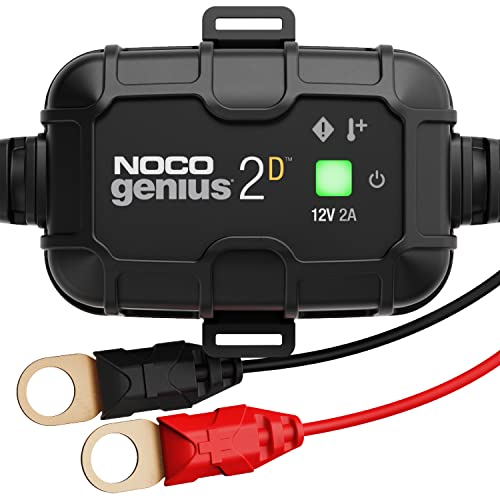
Best for: drivers who want a compact, all-in-one onboard solution for 12V lead-acid batteries (AGM, Gel, SLA, VRLA) and similar configurations. The GENIUS2D combines charging, maintenance, desulfation, and temperature compensation in a single unit that mounts directly near the battery. It’s ideal for under-hood installations in cars, trucks, boats, and RVs where space is at a premium and a reliable, maintenance-focused approach is required.
Why selected: Its direct-mount design minimizes clutter and offers a robust, integrated solution for ongoing battery health. By including a desulfator and temperature compensation, it helps extend battery life in varying climates. The direct-mount feature reduces exposure to connectors and enables a neater installation that’s well-suited for vehicles with restricted under-hood space.
Caution: Installation requires some surface prep and mounting hardware; improper mounting could lead to vibration or poor contact in rough conditions. Ensure compatibility with your battery type and mounting surface before proceeding.
Schumacher Electric 1.5A Car Battery Charger and Maintainer SC1300

Best for: hobbyists and casual users who want a simple, three-in-one device for cars, powersports, and marine batteries. The SC1300 provides charging, maintenance, and reconditioning in one unit, making it a practical option for vehicles that sit unused for extended periods or for boats and RVs with mixed battery types.
Why selected: The SC1300’s smart trickle charging mode helps protect batteries over time, reducing risk of overcharging. Its 1.5A charging rate is gentle on smaller batteries and maintenance modes support long-term health.
Caution: The device’s lower amperage means slower charging of larger or deeply discharged batteries. If you frequently recharge larger lead-acid or AGM packs from a dead state, consider higher-capacity options.
MOTOPOWER MP00205A 12V 800mA Automatic Battery Charger

Best for: budget-conscious owners who need a compact, all-in-one setup for 12V lead-acid batteries, including flooded, AGM, and gel cells. It’s suitable for cars, trucks, and motorcycles used in varied climates where automatic desulfation and safe standby are valuable.
Why selected: The MP00205A combines charging, maintaining, trickle capabilities, and desulfation with pulse current technology. It also emphasizes safety with spark-free operation and ETL safety standard listing, making it a practical entry point for basic maintenance routines.
Caution: The 800mA output is modest; expect longer charging times for larger batteries or those in deep discharge. It’s best for maintenance rather than rapid returns to full charge.
Battery Tender Plus 12V 1.25A Charger and Maintainer

Best for: users who require a smart, auto-maintain approach with a durable long-term warranty. The Battery Tender Plus is well-suited for cars, motorcycles, ATVs, and small boats that sit idle for extended periods.
Why selected: Its adaptive smart charging, combined with a four-step charging program, helps maintain battery health without overcharging. The kit includes cables and long reach, making installation convenient in tight spaces.
Caution: The 1.25A charging rate may be slow for large, deeply discharged batteries. It excels as a maintenance charger but won’t deliver rapid restoral when batteries are nearly dead.
Battery Tender 3 AMP Battery Charger and Maintainer

Best for: vehicles that demand quicker charging and consistent maintenance without oversizing the charger. The 3A rating is a middle ground for cars, trucks, and larger motorcycles or small boats.
Why selected: It provides a capable balance of charging speed and maintenance mode, with the convenience of a switchable 12V/6V option for different battery chemistries. The unit is designed for straightforward operation and long-term reliability.
Caution: While versatile, this charger’s higher amperage is still not ideal for very large deep-cycle batteries or vehicles that sit for months without use; consider a true multi-bank charger for those scenarios.
NOCO GENIUS2: 2A 6V/12V Smart Battery Charger

Best for: mixed-battery households needing a versatile, compact charger that supports lead-acid and lithium-ion batteries, including marine, deep-cycle, and standard automotive types.
Why selected: The GENIUS2 offers a flexible approach with Force Mode to re-engage severely discharged batteries and precise temperature compensation to optimize charging in hot or cold environments. It’s compact yet powerful for a wide range of applications.
Caution: For very large or high-current demands, pairing with a dedicated bank charger may yield faster results; use Gen2 in scenarios where space and convenience trump the need for aggressive charging.
Buying Guide: Key Considerations for Vehicle Mounted Maintainers
- Battery type compatibility: Confirm whether the maintainer supports lead-acid variants ( flooded, AGM, Gel) and lithium options if you use LiFePO4 or similar cells.
- Output amperage: Higher amperage chargers restore batteries faster but may be larger or generate more heat. Match to battery size and usage pattern.
- Mounting method: Direct-mount units save space and minimize brackets. Check your vehicle’s under-hood space and mounting surface integrity.
- Desulfation and maintenance mode: If you store a vehicle long-term, desulfation helps extend life. For frequent use, smart maintenance prevents self-discharge without overcharging.
- Temperature compensation: Essential in extreme climates to prevent overcharge in heat and undercharge in cold conditions.
- Safety features: Look for spark-free connections, automatic shutoff, and ETL/UL listings for peace of mind in daily use.
- Ease of installation: Consider included cables, mounts, and whether the unit ships with enough hardware for your mounting surface.
- Reliability and warranty: Longer warranties indicate confidence in durability; plan for environments with vibration or exposure to the elements.
FAQ: Quick Answers for Battery Maintainer Buyers
- What is a vehicle mounted battery maintainer? A device that charges and maintains a vehicle’s battery while it is installed, often with features like desulfation and temperature compensation.
- Do I need a desulfator? Desulfation helps revive or preserve lead-acid batteries by removing crystalline buildup, improving efficiency and lifespan when used properly.
- Can I use these on lithium batteries? Some models support lithium chemistries; check compatibility before connecting to LiFePO4 or other lithium chemistries.
- Is higher amperage better? Not always. Higher amperage charges faster but can overheat or stress smaller batteries. Choose based on battery size and usage.
- Will these work if my vehicle sits unused for months? Yes, maintenance modes help prevent self-discharge and sulfation during storage, but ensure proper battery conditioning for long-term storage.
- Do I need professional installation? Most direct-mount units are designed for DIY mounting with basic tools, but verify fit and mounting guidelines for your vehicle.